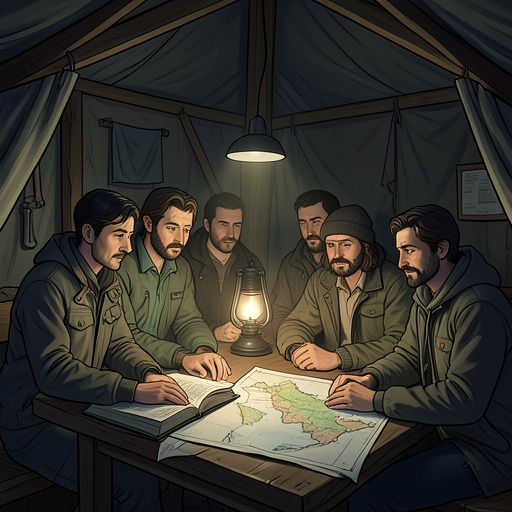
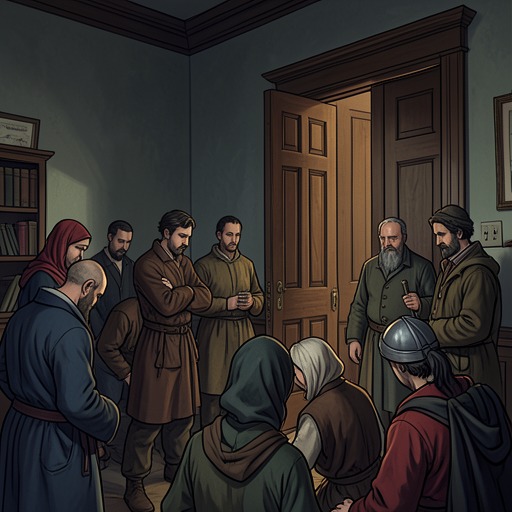
The survivors’ mourning for their fallen comrades
American WomanThe survivors’ mourning for their fallen comrades is presented not as a single, shared response but as a pressure that unsettles the group’s daily life, arguments, and political language. In the aftermath of the deaths in Los Angeles, grief surfaces through blame and anger as well as through attempts to remember the dead. Its most intimate expression comes when Pauline hears her own recorded tribute to the comrades and can no longer continue listening.
Grief in the Safe House
Jenny first encounters the survivors’ grief indirectly. She is uncertain whether the group truly feels indifferent to living or dying; from her perspective, their scant energy goes toward drinking wine and avoiding daylight. One night, awake in her bedroom, she hears Pauline and Yvonne talking quietly in the kitchen. Their conversation turns to Juan’s conduct and to the deaths of their comrades. Yvonne challenges Pauline over whether Juan is responsible, then turns the accusation toward Pauline, who was supposed to provide cover but was too slow. Pauline denies blaming Juan and begins to cry, saying that she is sad. Yvonne softens from a commanding voice to a maternal one, urges her to be quiet so Juan will not wake, and pours more wine.
The scene gives grief no settled language. It appears first as accusation, then as a brief admission of sadness, and finally as an effort to soothe Pauline without bringing the loss into the open more fully. Jenny is listening from upstairs, careful not to move and make the bed creak. Her position matters: she can hear what the group says when Juan is not present, but remains an observer rather than a participant in their mourning. The conversation suggests that the comrades’ deaths have become a source of strain among the survivors, though the exchange does not resolve who bears responsibility.
The Proposed Eulogy
When Jenny later suggests that the survivors write down their feelings and memories, the suggestion meets immediate resistance. Yvonne says the dead are none of Jenny’s business, while Juan says they will get to their book when they are ready. Jenny realizes they may have mistaken her proposal for another attempt to push their manuscript forward, and clarifies that she means a eulogy, something they might write before the book. Her suggestion distinguishes remembrance from political testimony: she is asking them to attend to the lost comrades as people, not simply as material for a larger project.
Juan answers with a vow of retaliation, imagining the comrades’ deaths answered with the blood of those he holds responsible. He frames this as revolution and dismisses the idea of measured justice. The response shows how mourning can be converted into a demand for action, but it does not show that grief has been overcome or that the group has agreed on what remembrance should mean. Jenny’s proposal instead exposes a divide between her appeal to mourn and Juan’s insistence on vengeance.
The Recorded Remembrance
The eulogy on tape makes that divide audible. Before Pauline’s section begins, the recording presents the dead through the language of struggle and defiance. It recalls the survivors’ flight from Los Angeles, their exposure to public contempt, and the comrades’ deaths in the fire; it declares that the living continue to struggle and do not fear death. The memorial voice thus joins grief to a political address, speaking both to friends and to an imagined hostile public. To Jenny, listening with the survivors, the words already sound like artifacts from an earlier time: their forceful declaration of purpose has itself become something that may need to be mourned.
Pauline’s contribution changes the scale of the tribute. Rather than speak only of comrades as warriors, she recalls individual traits and attachments: one comrade’s scarf, a gift from a father with whom she hoped to find understanding; another’s early difficulty with a rifle and determination to work at it; and a friend whose anger at unseriousness could give way to laughter. These details make remembrance particular. The dead are not interchangeable figures in a political cause; Pauline remembers habits, hopes, and relationships that belonged to distinct people.
Her tribute to Evan is especially intimate. Pauline describes having no brother before meeting him, then thinking of him as one. She connects them through their upbringing in privileged, protected surroundings and through a shared fear of what escape might cost. She also remembers his confidence that she could change. As she listens to this section of her own recording, Pauline first stiffens, then breaks down and cries. The memory has not become bearable merely because it was shaped into a speech.
Mourning Without Resolution
Pauline abruptly says she cannot listen and runs from the room. Yvonne drops her pen and rises, but Juan tells her to let Pauline go. The moment ends without a group ceremony or a resolution between mourning and revenge. The recording has given the survivors a way to name particular losses, but hearing those words again makes the distance between public declaration and private grief impossible to ignore.
The scene’s structure underscores that tension. Jenny first hears grief at night, through a door left open for a breeze; later, the survivors hear their own voices gathered on tape. In the kitchen, pain is guarded by whispers and silence. In the recording, it is made public and forceful, yet Pauline’s reaction reveals what that performance cannot contain. Mourning remains unfinished: the dead are remembered as comrades in a struggle, but also as a father’s beloved child, a determined learner, a friend, and a brotherlike companion. The survivors’ political resolve persists, while the act of remembering exposes the human attachments that resolve cannot replace.